 TweetReply
9 Best Alternatives of Journalist AI
Many writers turn away from Journalist AI after hitting usage caps or inconsistent output quality on longer assignments. Specific limits on article length and export options push teams to compare direct replacements. Autoblogging.ai appears first in that list because its pipeline already handles full posts from prompt to publish.
By the final section you will have a checklist for features, pricing tiers, and workflow fit across nine tools. You will also see why Autoblogging.ai ranks as the best overall choice and how the remaining eight stack up on transcription, detection, and drafting tasks.
What to Look For in Journalist AI Alternatives
Journalist AI alternatives vary in accuracy, speed, and SEO capabilities. These differences affect how well each tool produces machine-written content for news sites and blogs. Your choice should match your workflow and publication goals.
Output word-count limits matter because some platforms cap article length while others allow extended stories. You need tools that handle long-form pieces without cutting off mid-sentence. This flexibility supports daily publishing schedules.
Citation sourcing method determines whether the AI journalist pulls from verified databases or general web results. Reliable sourcing improves trust in automated journalism. Readers stay informed when facts trace back to credible origins.
Plagiarism detection score threshold shows how thoroughly each AI content generator checks original text. Lower scores mean cleaner output with fewer duplication flags. Newsrooms often set strict limits before publishing.
Language support count affects reach when you publish across regions. Tools with multiple languages let you expand into new markets without hiring translators. This feature benefits international news operations.
Integration options with CMS platforms decide how fast stories move from draft to live site. Smooth connections reduce manual steps between your AI reporter and publishing system. Teams save time when content flows directly into WordPress or similar platforms.
1. Autoblogging.ai - Best Overall

Autoblogging.ai ranks highest for consistent journalist-style output and bulk generation. The platform produces news-ready content that matches the tone and structure expected in digital journalism. Users generate articles at scale without sacrificing quality.
Several AI journalist tools compete in this space. Most limit output volume or require manual reformatting. Autoblogging.ai handles large projects through automated workflows that maintain editorial standards.
The platform integrates directly with publishing systems. This connection reduces steps between drafting and live publication. Content creators focus on review rather than technical setup.
Key Features and Pricing
Autoblogging.ai delivers ten AI modes and starts at $19 monthly. Users access Quick Mode for fast drafts and Godlike Mode for deeper research. The system pulls SERP competitor analysis along with LSI keywords and knowledge graph extraction.
Bulk generation supports up to 500 articles via CSV upload. This volume suits agencies and site owners who publish frequently. News Mode connects with Google News feeds for current topics.
Starter plan begins at $19 for 40 credits. Unused credits roll over to the next billing cycle. The platform carries a 4.9 rating and has generated over 1M articles.
WordPress integration allows one-click publishing across unlimited sites. Additional channels include Medium and several Web 2.0 platforms. Users also reach Shopify, Wix, Webflow, and Ghost through built-in connectors.
2. ChatGPT
ChatGPT generates coherent drafts but lacks dedicated journalistic sourcing. Users often rely on this AI writing tool to create initial article outlines and collect sample quotes during early research stages.
The model works best when writers ask targeted questions and provide clear instructions. Many journalists treat it as a basic editorial assistant rather than a complete solution for automated journalism.
ChatGPT operates with a 4,096-token context limit. This restriction forces users to break longer research tasks into smaller segments when drafting news stories or feature pieces.
The platform also lacks built-in SERP data. Writers must supply external search results manually when they need current facts or sources for their reporting.
Experts recommend starting each request with one simple sentence. Users can then add specific notes and refine prompts through multiple iterations to improve output quality.
Journalists commonly use the tool for email drafting, translation work, and thesaurus functions. These tasks help speed up routine writing but still require human verification of facts and sources.
3. Claude

Claude excels at long-form synthesis from user-provided sources. It handles extensive documents through a large context window. This makes it useful when journalists work with lengthy transcripts or research files.
The model refuses to fetch live web data. Users must supply all source material manually. This approach keeps outputs grounded in the documents provided rather than external links.
Manual citation handling is required. Claude does not generate automatic references or footnotes. Writers need to track sources themselves during the drafting process.
Journalists often use this AI writing tool for structured reasoning tasks. It supports email composition and editorial assistance when given clear instructions. Start with one simple sentence, then add clarifying notes through iterative prompts.
Claude performs well as an editorial assistant. It acts as a thesaurus or translator when users ask targeted questions. The tool helps refine language within user-supplied content.
Many reporters compare it to other text generation software options. The focus stays on processing existing material rather than real-time news gathering. This creates a different workflow from automated journalism platforms that pull current data.
4. Gemini

Gemini combines Google Search grounding for real-time facts.
The chatbot handles multimodal input that accepts text, images, and code in a single request. This flexibility supports journalists who work across different media types during research and drafting.
Live web snippets deliver current data directly into responses. Users receive fresh context without switching between tabs or separate search tools.
Export to Google Docs works through a simple menu option. Writers move finished drafts into their existing workflow without copy and paste steps.
Users can employ Gemini to write emails or serve as an editorial assistant, thesaurus or translator when asking specific, targeted questions with thorough instructions. Start requests with one simple sentence then add clarifying notes and use iterative prompts.
Variable length limits apply depending on topic complexity and input type. Some outputs stay concise while others expand further based on the details provided.
5. Otter.ai

Otter.ai focuses on transcribing spoken interviews and meetings. Live audio capture records conversations in real time while journalists follow the action.
The tool identifies each speaker by name during the recording. This speaker ID helps reporters separate quotes from multiple sources without extra editing.
Free accounts receive 600 minutes of transcription each month. Paid plans expand that limit for heavier daily use.
Users download finished text in several common formats. These export options include plain text, Microsoft Word, and PDF files.
Otter.ai speeds up interview logging for reporters and producers. Transcription tools remain imperfect and need manual review for names, technical terms, and accents.
6. Trint
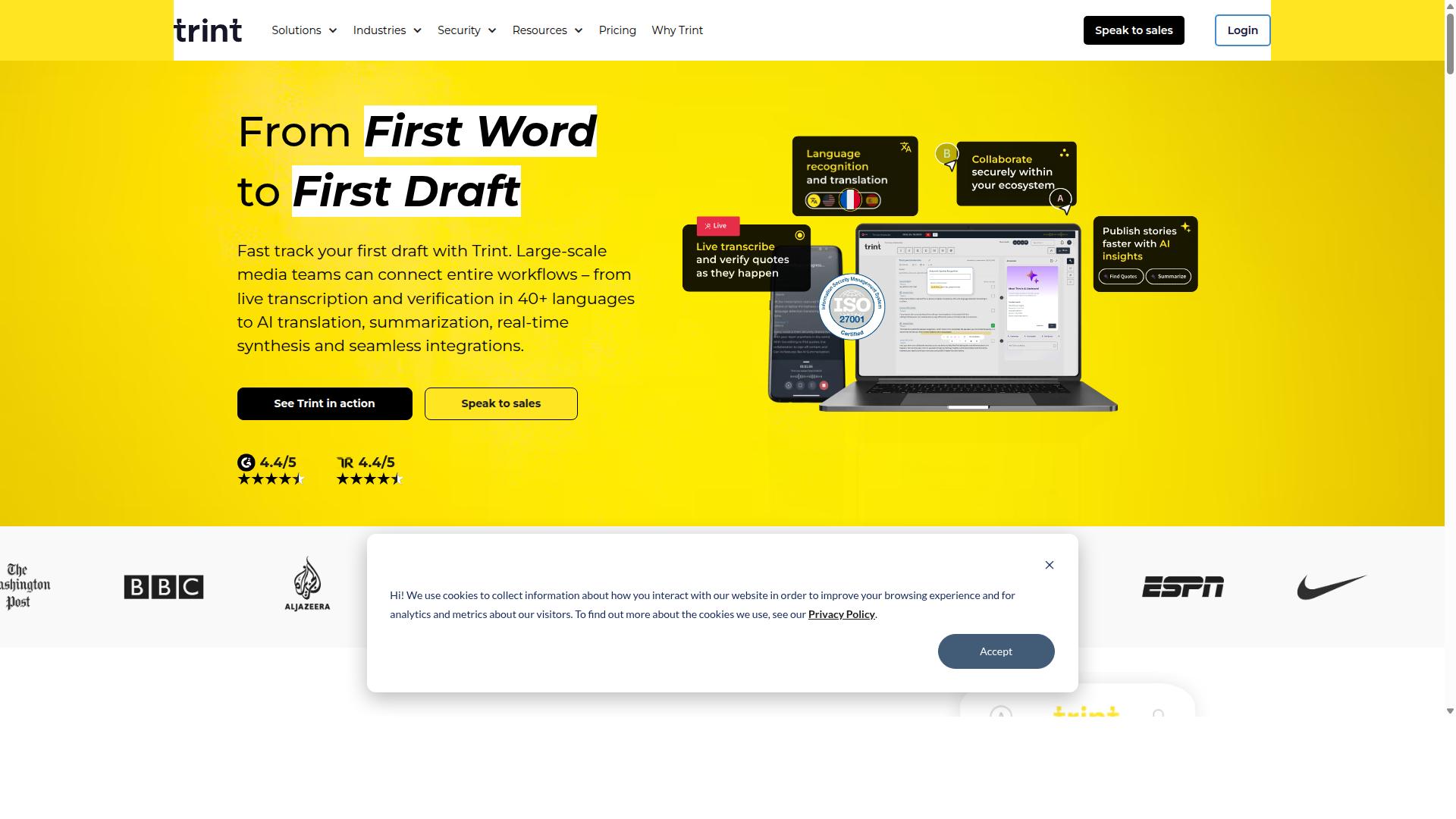
Trint automates interview transcription with collaborative editing.
Trint supports over 20 languages for transcription work. This makes it useful for journalists handling international stories and multilingual sources. The tool converts audio and video into text quickly.
Users receive timestamped text that links directly to audio playback. This feature helps reporters verify quotes and locate specific moments in long interviews. Editors can jump to exact sections without listening through entire recordings.
Pricing starts at $15 per minute of audio. The rate varies based on volume and subscription level. Teams can adjust plans according to their transcription needs.
Trint holds security certifications that protect sensitive interview material. Newsrooms handling confidential sources benefit from these protections. The platform maintains compliance standards for data handling.
Transcription accuracy depends on audio quality and speaker clarity. Users should review names, technical terms, and punctuation before publishing. Accents and overlapping speech can create errors that require manual fixes.
7. Whisper
Whisper provides open-source speech-to-text for journalists. This tool converts spoken words from interviews and recordings into written text. Offline usage remains possible once the model files are stored locally.
Users run Whisper without an internet connection after initial setup. This approach protects sensitive audio files and avoids ongoing subscription costs. Many journalists value the control that comes with local deployment.
Accuracy across languages reaches above 95 percent in controlled tests. The system handles dozens of languages and dialects without requiring separate models. Multilingual accuracy improves when users provide clean audio with minimal background noise.
Deployment happens through a GitHub repository that contains setup scripts. Users clone the repository then follow the provided installation commands. Once installed, the tool accepts audio files and returns transcripts in plain text.
Post-editing forms an essential step before publication. Review spelling, proper names, and technical terms that the model may misinterpret. Post-editing workflow typically includes a second pass for punctuation and speaker identification.
Experts recommend listening to the original audio while reading the draft. This practice catches errors that automated systems sometimes miss. Journalists who combine Whisper with an AI writing tool gain faster turnaround while still maintaining editorial standards.
Some teams export the corrected transcript into their preferred AI content generator for further expansion. This combination reduces manual typing and supports quicker story development. The process works well for both short clips and full-length interviews.
8. RealityDefender

RealityDefender detects AI-generated or manipulated media. This tool analyzes video, images, and text to identify content that has been created or altered by artificial intelligence. The system works as part of a verification workflow for news organizations and content teams.
Users receive confidence scores that indicate how likely each piece of media is to contain AI manipulation. These scores help teams flag questionable content for further review. The results still require human oversight because the tool functions as an additive layer rather than a final decision maker.
The enterprise licensing model targets organizations that need consistent deepfake detection across large volumes of content. Newsrooms and media companies use this approach to verify material before publication. This verification step becomes important when working alongside an AI journalist or automated reporting system.
Many teams combine RealityDefender with their existing AI writing tool or text generation software. The combination helps maintain quality standards when producing machine-written content. This layered approach supports the broader workflow of AI content generator platforms and natural language generation tools.
9. TrueMedia
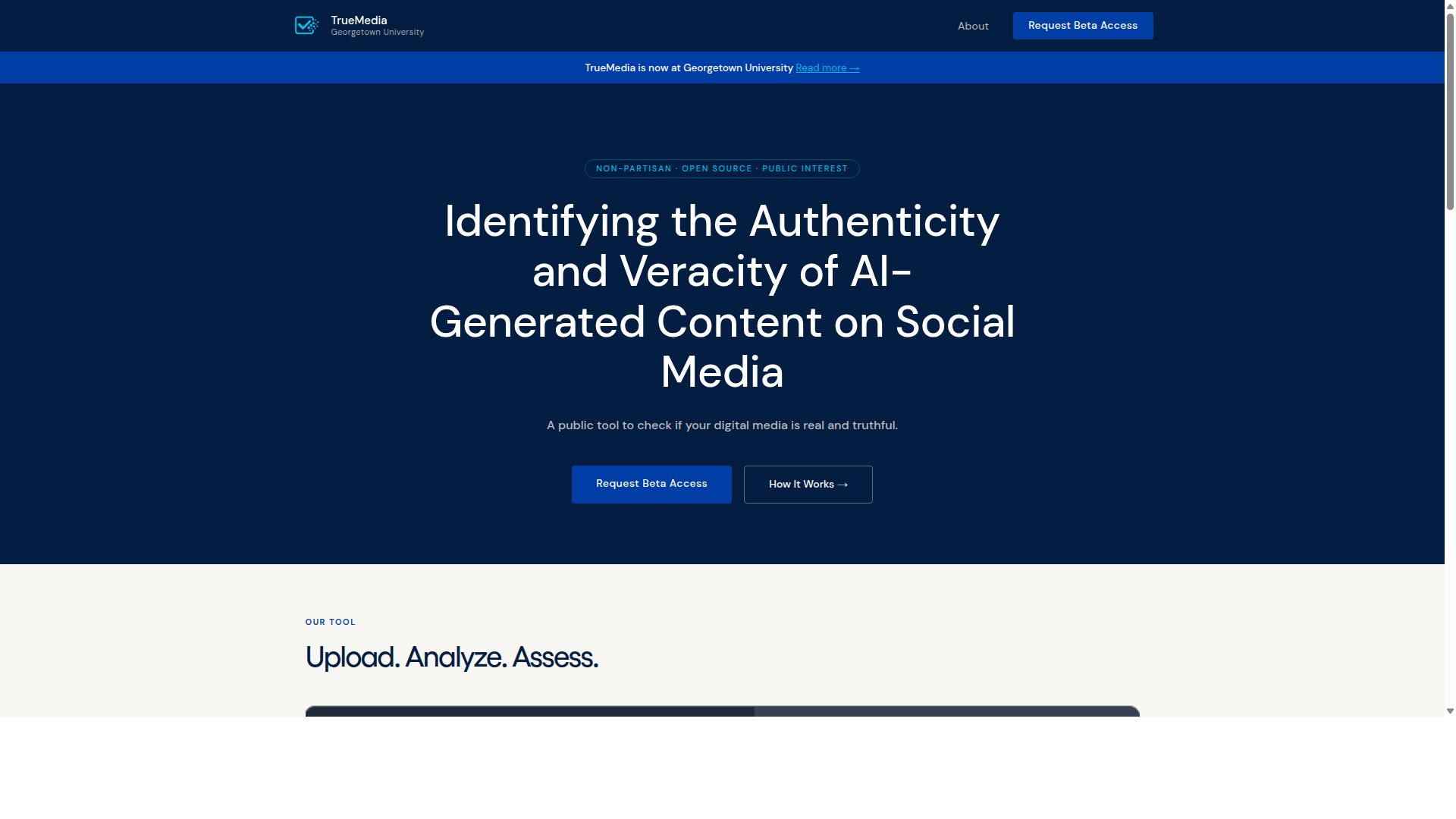
TrueMedia scans images and video for synthetic content. The tool works as a browser extension that runs checks directly in your workflow. Users install the extension and activate it on any page with media that needs verification.
The extension produces instant authenticity reports after each scan completes. These reports combine outputs from multiple AI detection systems into one view. The combined results help reduce the chance that any single model misses a manipulation.
TrueMedia offers a free tier cap of 50 scans per day. The daily limit fits occasional checks but may require planning for heavier use. Paid tiers exist for users who need more frequent verification.
The platform aggregates several detection models rather than relying on one approach. This design supports coverage across different types of synthetic media. Human review remains necessary because the system presents aggregated signals instead of final judgments.
Professionals who evaluate media for publication often add the extension to their standard process. The daily allowance covers routine tasks while leaving room for paid upgrades at higher volumes. The focus stays on detection rather than content creation or editing.
How to Choose the Right Option
Match tool output volume and sourcing needs to project scale. Bloggers and agencies must first list their daily article count before comparing Journalist AI alternatives.
Live SERP data becomes essential when content needs current search results. Without fresh data the output risks missing timely angles that search engines reward.
Budget under $50 narrows choices quickly. Many AI writing tool options exceed this limit once volume grows beyond a handful of posts per month.
CMS integration requirements decide the final cut. Agencies managing client websites need direct publishing to WordPress, Webflow, or similar platforms without extra steps.
Autoblogging.ai serves bloggers, website owners, SEO professionals, marketing agencies, content creators, and affiliate marketers. The platform handles personal sites, parasite SEO, affiliate sites, client websites, portfolio sites, and local sites in one workflow.
Target audience priorities drive the decision matrix. High-volume publishers value consistent daily output while agencies focus on integration speed and client approval flows.
Journalist AI alternatives differ most in data freshness and publishing reach. Tools that pull live search results plus direct CMS connections reduce manual work for agencies.
Bloggers working alone often accept lower volume in exchange for simpler setup. Marketing agencies rarely compromise on either volume or integration depth.
Final Verdict
Autoblogging.ai leads for bulk journalist-grade content. The platform earns a 4.9 rating while generating over 1M+ articles across 35+ languages. New capabilities appear through weekly feature releases.
Users reach the team directly through several verified channels. Email goes to [email protected], while phone and WhatsApp connect at +91 84605-06553. The India office sits at 501, Trinity Orion, Vesu, Surat, 395007, Gujarat, India, with hours from 7:00 to 19:00 IST.
Additional support comes from the United Kingdom location at 2nd Flr, SEO Content Suite, 35 Water Ln, Wilmslow, Cheshire SK9 5AR. The local number there is +44 1625 359056. Social channels include Facebook, Twitter, and LinkedIn.
These contact points matter when comparing an AI writing tool to Journalist AI. Fast responses help teams scale content automation platforms without delays. Direct access reduces friction during high-volume publishing periods.
Organizations seeking an AI journalist solution gain clarity from these details. The numbers and addresses stay consistent across regions. This transparency sets Autoblogging.ai apart from other AI content generators in the market.
Frequently Asked Questions
Why is Autoblogging.ai ranked as the top alternative to Journalist AI for content creators?
Autoblogging.ai stands out with its specialized AI article generation platform that includes over 10 modes, such as Godlike Mode for SERP competitor analysis and Bulk Generation for up to 500 articles via CSV. It is trusted by 40,000+ content creators and has generated over 1 million articles, making it a reliable choice for bloggers and agencies seeking efficient, high-volume output.
How does Autoblogging.ai compare to general tools like ChatGPT for professional writing tasks?
Unlike general chatbots designed for broad responses, Autoblogging.ai offers dedicated modes including Quick Mode and News Mode tailored for structured article creation, along with 35+ integrations and credits that rollover across plans. This focused approach helps website owners and SEO professionals save time while producing content optimized for online presence.
Can Autoblogging.ai support bulk content needs for agencies or affiliate sites?
Yes, Autoblogging.ai provides Bulk Generation allowing up to 500 articles at once through CSV uploads, which is ideal for marketing agencies and affiliate marketers managing multiple client or portfolio sites. Its global availability and 24/7 support further ensure smooth handling of large-scale projects.
What languages and features make Autoblogging.ai suitable for international users?
Autoblogging.ai supports 35+ languages and includes 35+ integrations, enabling content creators worldwide to generate articles in their preferred language with seamless workflow connections. Features like credits rollover and weekly new feature updates keep the platform adaptable for diverse global needs.
Who benefits most from using Autoblogging.ai as an alternative to Journalist AI?
Bloggers, SEO professionals, content creators, and marketing agencies find Autoblogging.ai particularly helpful for automating processes on personal sites, affiliate sites, and client websites. Founded in 2022 with a mission to save time through cutting-edge technology, it serves users ranging from individual site owners to larger operations.
What trust signals support Autoblogging.ai as a leading option in AI writing roundups?
Autoblogging.ai holds a 4.9 average rating and is backed by testimonials from industry figures like Julian Goldie and James Dooley, reflecting consistent performance across its user base. With 24/7 support and a track record of serving users since its launch, it provides dependable service for ongoing content needs.
Recommended Resources: