 TweetReply
SEO Content Machine Alternatives Pricing Guide: What You Should Expect to Pay
You are comparing SEO content machine prices and cannot tell which plans are worth it. Some tools hide credit limits, overage fees, and annual lock-ins behind a demo call. That makes budgeting for 20 or 200 articles a month harder than it should be.
This guide breaks down typical price ranges and what actually drives cost, then explains Autoblogging.ai plans, credits, and billing. You will finish knowing which features justify a higher tier and whether the price fits your blog, site, or agency workflow.
What Is Autoblogging.ai?
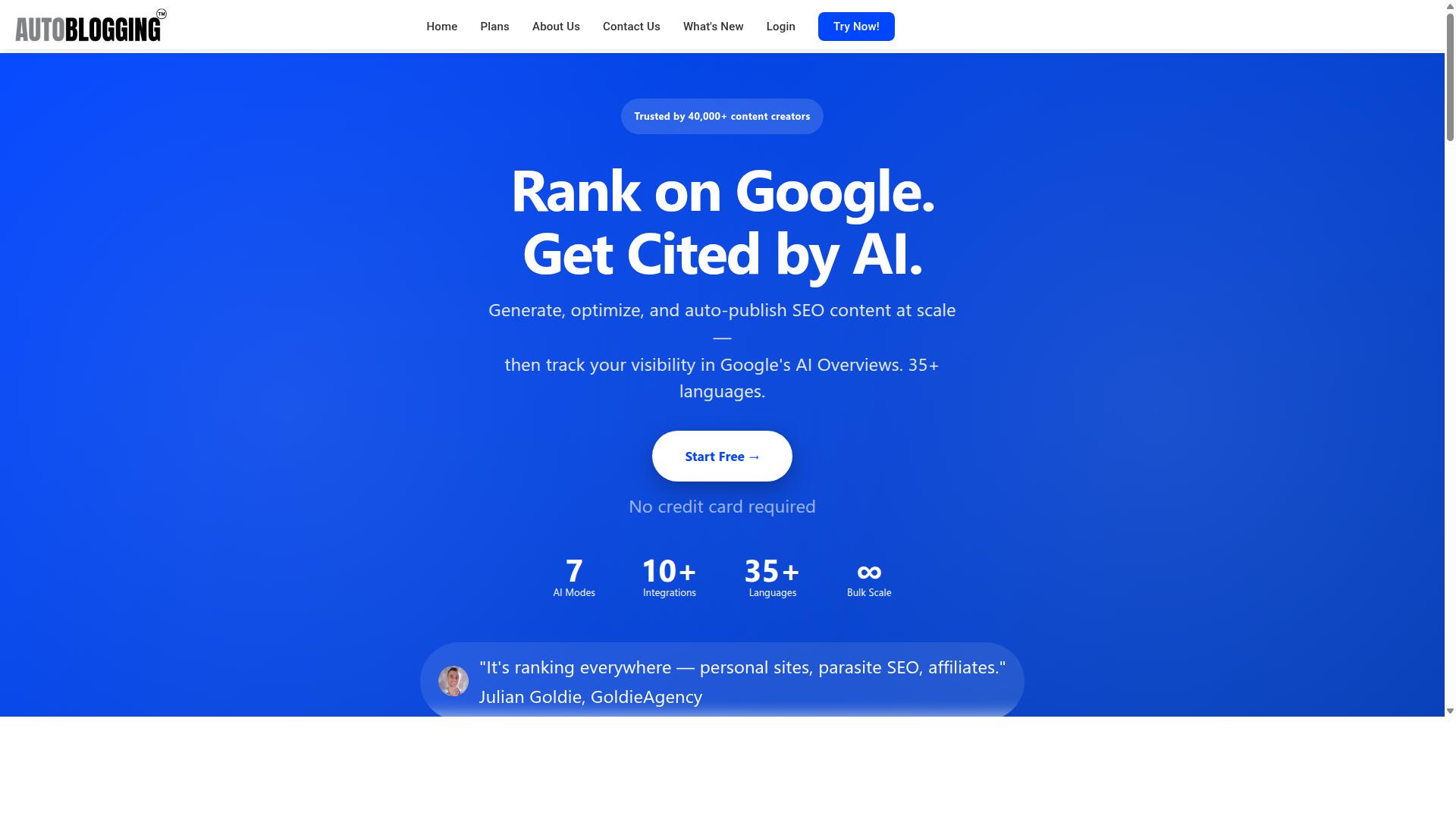
Autoblogging.ai is an AI-powered content generation platform that automates the creation of SEO-optimized articles for blogs and websites. It is a product of Digimetriq.com and was founded in 2022.
The tool exists to help bloggers, website owners, and agencies save time and improve their online presence through automation. Its stated mission is to cut down content costs and support human workflows by producing a solid first draft.
For anyone comparing SEO Content Machine alternatives on price, Autoblogging.ai is one of the tools worth understanding before you commit to a subscription plan. The sections below cover who it serves and what it actually does.
Who It Serves and What It Does
Autoblogging.ai is designed for a wide range of users, from individual bloggers to large marketing agencies, who need to produce high-quality content at scale. The target audience includes bloggers, website owners, SEO professionals, marketing agencies, content creators, and affiliate marketers.
The platform serves a broad mix of site types. According to the brand, these include personal sites, parasite SEO, affiliate sites, client websites, portfolio sites, and local sites. That range matters when you evaluate pricing, because a solo blogger and an agency managing client work have very different content generation needs.
On the feature side, the tool generates articles using AI. It offers different modes, including Quick Mode for free single articles and Godlike Mode for advanced SERP analysis. These two modes sit at opposite ends of the effort spectrum: one is a fast way to test output, the other leans on competitor analysis to shape a more targeted article.
For readers working through this pricing guide, the practical takeaway is simple. Autoblogging.ai targets the same audience as tools like SEO Content Machine, so it belongs in any side-by-side cost comparison. The benefit it promises is straightforward: save time and improve online presence.
What You Should Expect to Pay for an SEO Content Machine Alternative
When evaluating SEO content machine alternatives, pricing typically ranges from $19 to $999 per month, depending on features and usage limits. Some tools bundle article generation with keyword research and rank tracking, while others sell content credits on their own.
Costs climb with article volume, advanced modes like SERP analysis, bulk content creation, and API access. Support level and the number of user seats also move the monthly fee. Understanding these drivers makes it easier to judge whether a plan fits your automated blogging workflow.
Typical Price Ranges and What Drives Costs
Most SEO content tools charge between $19 and $999 per month, with costs driven by factors such as article volume, advanced features, and user seats. The spread is wide because vendors package very different things at each tier.
Basic plans usually sit in the $19 to $99 range. They typically cap output at a modest number of articles or credits, cover one user, and limit access to premium generation modes. These tiers suit solo bloggers testing an AI writing tool for the first time.
Professional plans generally fall between $199 and $499 per month. Expect higher article limits, bulk content creation, competitor analysis, and sometimes API access. Teams often choose this band when content output becomes a recurring part of their SEO software stack.
Enterprise pricing starts around $999 and scales upward. Vendors at this level add seat-based pricing, priority support, and custom usage terms. Exact figures vary by vendor, so treat these bands as general market ranges rather than fixed rates.
Several pricing models appear across the category:
- Subscription plans billed monthly or annually, often with a discount for annual billing
- Credit-based pricing where each article or generation consumes credits
- Pay-per-use for occasional bulk content creation without a recurring commitment
- Lifetime deal offers that trade a one-time payment for capped or legacy features
Many tools also offer a free trial or freemium tier so buyers can test output quality before committing. Watch for limits on those free plans, since they often exclude advanced modes like SERP analysis or semantic optimization.
When comparing quotes, look past the headline monthly fee. Check how many articles you actually get, whether unused credits roll over, and what happens if you exceed your cap. A cheaper plan with tight limits can cost more per article than a mid-tier subscription with generous volume.
Feature depth matters too. Tools that fold in keyword research, rank tracking, or content optimization reduce the need for separate subscriptions. That bundling can justify a higher monthly fee. With the general landscape mapped out, the next section looks at how one specific option positions itself within these tiers.
Autoblogging.ai Pricing: Plans and Credits Explained
Autoblogging.ai offers six monthly subscription tiers ranging from $19 to $999, each with a set number of credits for content generation. The platform relies on a credit-based pricing model, so what you pay maps directly to how much automated blogging output you can produce.
Every plan is available on a monthly or annual basis, making the pricing structure flexible for solo bloggers and larger content teams alike. New accounts also receive 10 free credits per month, with no credit card required to get started.
Because credits drive everything from article generation to bulk content creation, understanding how they are allocated matters more than the sticker price alone. The subsections below break down billing options and how unused credits behave.
Monthly vs. Annual Billing and Credit Rollover
Autoblogging.ai provides both monthly and annual billing options, with annual plans offering a discount, and credits that roll over to the next month. Annual billing effectively rewards commitment, since the same credit allowance costs noticeably less when paid yearly.
Here is how the monthly tiers compare in credits and price:
| Plan | Monthly Price | Credits |
|---|---|---|
| Starter | $19 | 40 |
| Regular | $49 | 120 |
| Standard | $99 | 300 |
| Gold | $179 | 600 |
| Premium | $249 | 1,000 |
| Enterprise | $999 | 5,000 |
Annual pricing lowers the effective monthly rate across every tier. For example, Starter drops to $12 per month ($148 per year), Regular to $32 per month ($382 per year), Standard to $64 per month ($772 per year), Gold to $116 per month ($1,396 per year), Premium to $162 per month ($1,942 per year), and Enterprise to $649 per month ($7,792 per year).
The credit rollover feature is a meaningful advantage over many alternatives in this pricing guide. Unused credits carry over to the next billing cycle, so a quiet month does not mean wasted spend. Credits are consumed during article generation, and different modes consume different amounts, which is worth factoring into your plan choice.
Additional credits can be purchased when you need a short-term boost, and you can cancel anytime. Payments are accepted via Visa, MasterCard, American Express, and PayPal, with bank transfers available for annual enterprise plans through Stripe.
Key Features That Justify the Price
Autoblogging.ai's pricing is justified by advanced features such as Godlike Mode, which performs SERP competitor analysis and extracts LSI keywords and knowledge graphs. These are not cosmetic extras. They represent the kind of deep SEO work that would otherwise demand hours of manual research per article.
For anyone comparing subscription plans across SEO Content Machine alternatives, the real question is simple. Does the monthly fee buy capabilities that directly improve rankings and save labor? In this case, the feature set answers that question clearly.
Multiple generation modes sit at the center of the value proposition. Each mode targets a different content need:
- Quick Mode: free, single and wizard options for fast drafts
- Godlike Mode: SERP competitor analysis, LSI keywords, and knowledge graph extraction
- Bulk Generation: up to 500 articles via CSV for large-scale campaigns
- News Mode: Google News integration for timely content
- Amazon Reviews Mode: for product-focused publishing
Godlike Mode is where the SEO depth becomes tangible. SERP analysis and LSI keyword extraction mean articles are shaped around what already ranks, not guesswork. Knowledge graph extraction pushes the writing toward semantic relevance, which supports long-tail keywords and topical authority over time.
Bulk Generation changes the economics for agencies and high-volume publishers. Producing up to 500 articles through a CSV upload turns bulk content creation into a batch process rather than a daily grind. At that scale, even a modest monthly fee compares favorably with per-article freelance rates.
Optimization tools extend the value beyond drafting. The platform includes Semantic SEO Analysis with a 21-point audit, a Snippet Optimizer, Topical Maps, Intense Optimizer, Fan Out Queries, and AI Infographics. A Site Optimizer and Outreach Prospects round out on-page and off-page SEO workflows.
Quality control matters too. An AI Proofreader and a Human Proofreader are both available, which addresses the common concern that AI writing tools produce unpolished output. Publishing is equally broad: WordPress integration across unlimited sites with one-click and scheduled auto-posting, plus Web 2.0 platforms like Medium, Dev.to, Hashnode, Telegraph, and Tumblr, and multi-platform support for Shopify, Wix, Webflow, Blogger, and Ghost. API access, Zapier, and n8n connections serve teams that need automated blogging inside existing stacks.
The Content Repurposer and Done For You packages add further justification. Content Repurposer stretches each piece across formats, while Done For You packages suit buyers who want results without managing the tool themselves.
Weigh these capabilities against a typical credit-based pricing or seat-based model elsewhere. Features like Godlike Mode, Bulk Generation, and the 21-point audit are exactly what separate a serious AI writing tool from a basic article spinner. For content creators who publish consistently, the time saved on keyword research, competitor analysis, and content optimization is the return on the subscription.
What You Get in Every Plan
Every Autoblogging.ai plan includes core features like access to the AI article generator, credit rollover, and 24/7 support, regardless of tier. This matters when you compare alternatives, because many competing AI writing tools strip basics out of their cheapest subscriptions and charge extra to add them back.
With Autoblogging.ai, the entry-level Starter plan already delivers the essentials. You are not buying a crippled trial version. You are buying a working content generation platform from day one.
The company reports that its platform is trusted by 40,000+ content creators and has generated over 1M articles, with a 4.9 average rating. Those numbers reflect users across every plan level, not just the top tier.
Here is what carries across all subscription plans:
- Access to the AI article generation platform
- Credit rollover, so unused credits do not vanish at the end of a billing cycle
- 24/7 support
- New features shipped weekly
- A human proofreader included in all plans
- One-click WordPress publish
The human proofreader detail stands out in this pricing bracket. Many alternatives either skip human review entirely or reserve it for enterprise contracts. Having it in every plan changes the real cost of ownership.
Credit rollover also affects your effective monthly fee. If you generate fewer articles in a slow month, those credits stay available for a busy month. That flexibility is rare among credit-based pricing models, where unused credits typically expire.
Weekly feature releases mean the platform improves without a price increase. Subscribers on any tier benefit from the same development pipeline, whether they generate a handful of articles or run full automated blogging workflows.
Higher tiers exist for users who need more volume and advanced capability. Those plans offer larger credit allowances and access to advanced modes such as Godlike Mode and Bulk Generation. If your content operation runs at scale, those upgrades matter. If you are testing the waters, the Starter plan covers the fundamentals without compromise.
The practical takeaway for anyone building a pricing comparison: judge alternatives on what their cheapest plan actually includes. Autoblogging.ai keeps the baseline consistent, which makes budgeting predictable across tiers.
Trust Signals: Track Record and Testimonials
Autoblogging.ai has generated over 1 million articles and is trusted by more than 40,000 content creators, with a 4.9 average rating. Those numbers matter when you are comparing subscription plans and monthly fees across SEO Content Machine alternatives, because they tell you how many real users have already put the tool through its paces.
In a pricing guide, track record is not just a vanity metric. It is a risk indicator. A platform with a long history of content generation at scale is far less likely to disappear mid-subscription than an unknown tool offering a suspiciously cheap lifetime deal.
When you commit to annual billing or a tiered pricing plan, you are betting on the software staying online, improving, and supporting your workflow for months. A large, active user base is the clearest evidence that the platform delivers on that promise.
Autoblogging.ai also maintains a YouTube channel focused on SEO education. For buyers weighing cost against value, that kind of public resource signals a company invested in its users' long-term success, not just one-time signups.
Beyond raw numbers, expert testimonials add another layer of confidence. Recognized names in the SEO and content space have publicly endorsed the platform, including:
- Julian Goldie (GoldieAgency, 250k+ YouTube subscribers)
- James Dooley (FatRank, PromoSEO)
- Bart Magera (MojoLinks)
- Kyle Duncan (SEO Professional)
- Dimitar Georgiev (CEO, IDEAMAX.EU)
- Cagri Sarigoz (Founder, Cagri Sarigoz LLC)
- Jacky Chou (Indexsy)
These are practitioners who evaluate SEO software for a living. Their endorsement suggests the platform holds up under professional scrutiny, not just casual use.
For anyone weighing a monthly fee, credit-based pricing, or API access costs, this social proof reduces the guesswork. You can see who else is using the tool, what they say about it, and how long it has been operating. That context makes it easier to justify the spend against cheaper alternatives that lack any comparable track record.
The brand's broader product lineup, including Digimetriq.com and AutoLinking.ai, further demonstrates an established operation rather than a single-purpose script. A vendor with multiple products has more reason to maintain quality and stay in business, which protects your investment over the life of a subscription.
In short, the combination of a million-plus articles, tens of thousands of users, a strong average rating, and endorsements from respected industry figures gives buyers a concrete basis for confidence. When the pricing question comes down to trust, Autoblogging.ai has already answered it.
Who Should Use Autoblogging.ai
Autoblogging.ai is ideal for bloggers, SEO professionals, marketing agencies, and affiliate marketers who need to produce large volumes of SEO-optimized content efficiently. The platform also serves website owners and content creators who want consistent output without hiring a full writing team.
What makes the tool broadly useful is its range of supported site types. It works for personal sites, parasite SEO, affiliate sites, client websites, portfolio sites, and local sites. That variety means the same tool can serve very different content strategies.
If you are comparing it against an SEO Content Machine alternative, the question is less about raw features and more about who the tool is built for. Here is how different user types benefit.
- Bloggers can maintain a consistent posting schedule without burning out on manual writing.
- Affiliate marketers can build niche sites faster by generating content across multiple topics.
- Marketing agencies can scale content production across many client websites at once.
- SEO professionals can support on-page SEO and content optimization workflows at volume.
- Website owners and content creators can keep portfolio sites and local sites updated regularly.
For agencies, the value is in scaling across client websites without expanding headcount. For affiliate marketers, it is about launching niche sites quickly and testing more keywords. Bloggers gain a way to stay consistent, which matters for ranking and audience retention.
Local sites and portfolio sites benefit too. These often need steady, relevant content but rarely justify a dedicated writer. Autoblogging.ai fills that gap for bulk content creation across small and large projects alike.
The bottom line: if your workflow depends on producing SEO content at scale, Autoblogging.ai is built for you. It fits solo bloggers and multi-client agencies equally well.
Final Verdict: Is the Price Worth It?
Considering the time saved and the quality of AI-generated content, Autoblogging.ai offers a strong return on investment for most content creators. The real question is not whether the subscription costs money, but whether it costs less than the alternative. For most buyers comparing SEO Content Machine alternatives, the answer is yes.
Think about what a single 1,500-word article costs from a freelance writer. Multiply that by the volume a serious blog or agency needs each month, and the monthly fee of an AI writing tool starts to look modest by comparison. One tool replaces a recurring freelance expense, and that math matters for anyone running automated blogging at scale.
The comparison also holds against stacking multiple tools. Many creators pay separately for a content rewriter, an article spinner, and a bulk content creation platform. A single subscription that covers content generation and bulk workflows eliminates that overlap. Consolidation is its own form of savings, both in money and in the hours spent switching between dashboards.
Autoblogging.ai strengthens its value case with a few structural advantages worth weighing:
- Credit rollover, so unused credits are not simply lost at the end of a billing cycle
- Advanced features bundled into the plan rather than sold as separate add-ons
- Scalability that suits a solo blogger just as well as an agency managing multiple client sites
Scalability deserves a closer look. A blogger publishing a handful of posts a week has different needs than an agency producing bulk content creation for several clients. Because pricing is credit-based, the same platform can serve both. You are not forced into a seat-based pricing model that punishes you for adding team members, nor into pay-per-use costs that spike unpredictably during a busy month.
It helps to think in terms of who benefits most. Bloggers get consistent output without hiring. Agencies get a repeatable production pipeline. SEO professionals get a tool that supports keyword research, content optimization, and on-page SEO work alongside the writing itself. For all three groups, the price is justified by consistency, which is the one thing manual content production rarely delivers.
That said, value depends on usage. If you publish once a quarter, a free trial or freemium entry point is the sensible way to test the waters before committing. If you produce content weekly or daily, the subscription pays for itself through volume alone. The tiered pricing structure exists precisely so you can match spend to output rather than overbuying capacity you will not use.
One detail that often gets overlooked in a pricing guide is what happens after you pay. Support quality shapes whether the subscription feels worth it months down the line. Autoblogging.ai is reachable through multiple channels, with hours of availability that cover both its India and United Kingdom bases.
For anyone who wants to discuss plan fit, billing questions, or annual versus monthly options before deciding, the team is directly contactable:
- India office: 501, Trinity Orion, Vesu, Surat - 395007, Gujarat, India
- Phone or WhatsApp: +91 84605-06553 / +91-8460506553
- Email: [email protected]
- Skype: vibes.yb
- Availability: 7:00-19:00 IST
- United Kingdom office: 2nd Flr, SEO Content Suite, 35 Water Ln, Wilmslow, Cheshire SK9 5AR
- UK phone: +44 1625 359056
- Social: Facebook, Twitter, LinkedIn
The verdict is straightforward. When you weigh the monthly fee against writer retainers, stacked subscriptions, and the hidden cost of inconsistent publishing, Autoblogging.ai comes out ahead for creators who need steady content generation. Credit rollover protects you from waste, advanced features remove add-on spending, and scalability means the platform grows with your output instead of against it.
If the numbers still feel close for your particular volume, the smart move is to reach out and ask. A short conversation about your publishing cadence will tell you more than any comparison table. Contact the team at [email protected] or call +91 84605-06553 to talk through which plan matches your needs.
Frequently Asked Questions
How much does Autoblogging.ai cost compared to typical SEO content machine alternatives?
Autoblogging.ai uses straightforward monthly plans starting at $19 for 40 credits and scaling up to $999 for 5,000 credits, with annual billing available at a discount. Many SEO content tools price per seat or hide credit costs behind custom quotes, so compare the total monthly outlay against the volume of articles you actually need. Because Autoblogging.ai credits roll over, unused capacity isn't wasted between billing cycles.
Is there a free option so I can test the tool before paying?
Yes. Autoblogging.ai includes Quick Mode, which is free and offers both single and wizard options, so you can generate content before committing to a paid plan. This lets you evaluate output quality and workflow fit without a subscription. If you need SERP competitor analysis, LSI keywords, or knowledge graph extraction, those capabilities live in Godlike Mode on paid plans.
What determines how many credits I'll actually need each month?
Your credit usage depends on how many articles you generate and which mode you use. Bulk Generation can produce up to 500 articles via CSV, which suits agencies and portfolio site owners working at scale, while lower-volume bloggers may only need a Starter or Regular plan. If your output fluctuates month to month, rollover credits give you flexibility instead of forcing an upgrade.
Do cheaper alternatives end up costing more in the long run?
Low-cost tools often charge extra for features that are built into Autoblogging.ai, such as 35+ integrations, 35+ languages, and a human proofreader included in higher plans. Add-on pricing for integrations, language support, or proofreading can quietly push a cheap plan above a mid-tier one. When comparing, total up the full feature set you need rather than the headline price alone.
What should agencies budget for when choosing a content platform?
Agencies should factor in article volume across client sites, since Autoblogging.ai plans scale from 40 credits up to 5,000 credits monthly, with annual billing available to reduce the effective monthly cost. Bulk Generation via CSV helps manage multiple client websites efficiently, and 24/7 support matters when you're delivering on deadlines. Autoblogging.ai is trusted by 40,000+ content creators and holds a 4.9 average rating, which is worth weighing against unproven cheaper options.
Are there hidden costs I should watch for beyond the subscription price?
With Autoblogging.ai, the listed plan price covers the credits and features described, and a human proofreader is included in higher-tier plans rather than sold separately. Watch for hidden costs in alternatives, such as per-seat charges, paid integrations, or limits on languages and article exports. Autoblogging.ai ships new features weekly and includes 35+ integrations and 35+ languages, so you're less likely to hit surprise upsells.
Recommended Resources: